


Maximize Your Nissan Rogue Cargo Space
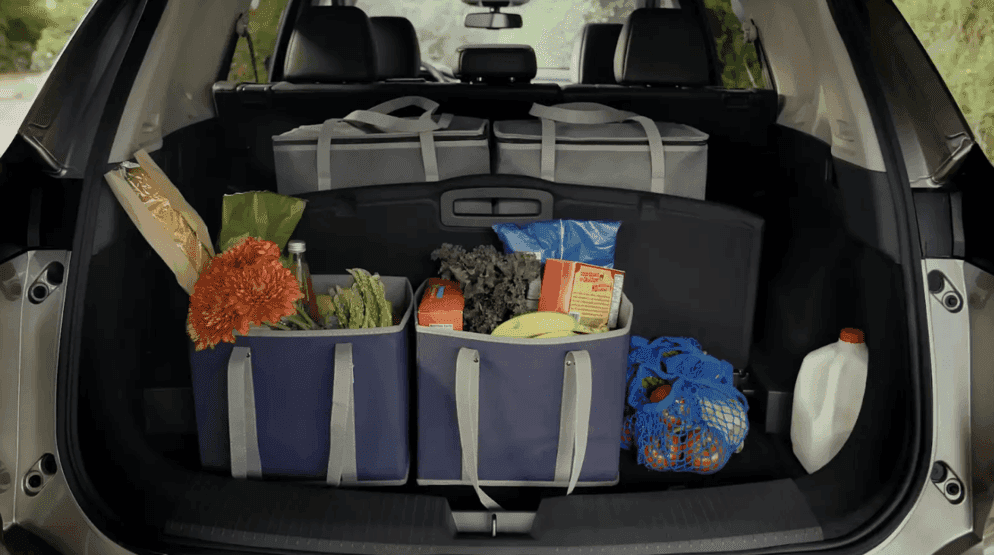
Photo Source/Copyright: NISSAN USA
Every Nissan Rogue trim, from the base S up to Platinum, maxes out at 74.1 cubic feet once the rear seats fold flat. Where shoppers run into confusion is the seats-up number. Most comparison charts print a single figure for behind-the-row cargo, but they’re almost always quoting the flagship trim with its modular floor in its lowest setting.
Here’s what the cargo volume actually looks like across the lineup.
The Real Trim-by-Trim Breakdown
Nissan splits the Rogue’s cargo bay dimensions into two setups:
- S, SV, Dark Armor, and Rock Creek (31.6 cubic feet): With five passengers in their seats, you get a clean, flat trunk floor. It will swallow a week’s worth of family groceries, a couple of standard suitcases, or an unfolded stroller without blocking your rearview mirror.
- Platinum with Divide-N-Hide Lowered (36.5 cubic feet): Dropping the two floor panels down to the bare steel pan adds 4.9 cubic feet of usable vertical clearance. That extra depth is what lets you stand tall coolers or golf bags upright.
- All Trims with Second Row Folded (74.1 cubic feet): Drop the 60/40 bench, and an entry-level S carries just as much cargo as the pricier Platinum. You don’t have to buy the top trim just to haul flat-pack furniture home from Ikea.
If you’re looking at the three-row Rogue Plug-in Hybrid, the packaging changes substantially: you get 12.8 cubic feet behind the third row, 30.8 cubic feet with row three stowed, and 64.7 cubic feet total.
Divide-N-Hide Utility and Daily Hauling
The 4.9-cubic-foot bump on the Platinum isn’t just marketing math. Nissan’s Divide-N-Hide system uses two multi-level panels. Dropped low, they maximize vertical height.
Raised, they sit flush with the folded seatbacks to create a continuous loading ramp with a concealed lockbox-style floor underneath. You can also slot one panel vertically as a trunk partition to stop grocery bags from tipping over on the drive home.
Cargo volume on paper is one thing, but how the cabin is packaged matters just as much:
- Nearly 90-degree rear doors: Nissan hinged the back passenger doors to swing open almost perpendicular to the body. That makes wrestling a bulky, rear-facing child safety seat or threading an eight-foot piece of baseboard trim through the side far less annoying.
- Split-folding bench: The 60/40 rear seat slides and reclines. Fold only the narrow section, and you can slide snowboards straight down the middle while two passengers stay seated.
- Practical tie-downs: Four steel tie-down loops come standard, alongside a molded side cubby specifically sized to wedge a one-gallon milk jug so it can’t roll around.
- Rock Creek power hookup: Camping-oriented Rock Creek variants add a 12-volt accessory outlet directly inside the rear hatch for electric air mattresses and portable coolers.
Rogue vs. Honda CR-V and Toyota RAV4
Against its two main rivals, the Rogue trades blows cleanly. Honda’s CR-V still leads the compact crossover class in raw volume (up to 39.3 cubic feet behind the rear seats and 76.5 cubic feet overall).
However, the Nissan shines with its versatility. A floor that splits the hold into layers. Rear doors that open nearly square, which car-seat parents notice fast. The milk-jug holder. None of that shows up on a cubic-foot chart. You feel it the first Saturday you load up, though.
Meanwhile, Toyota’s RAV4 edges out the Rogue with seats up (37.6 cubic feet), but once you drop the rear bench, the Rogue’s 74.1 cubic feet handily beats the RAV4’s 69.8 cubic feet.
Rooftop Capacity
When the hatch is packed to the ceiling, rail-equipped versions carry up to 220 pounds up top. Roof rails come standard on Dark Armor, Rock Creek, and Platinum trims (optional on SV). The Rock Creek includes a burly tubular platform, while other trims accept crossbars for bike racks, roof boxes, or kayak mounts.
More From Southern Team Nissan of Roanoke
Nissan Rogue 4-cylinder MPG: Fuel Efficiency Guide
Photo Source/Copyright: NISSAN USA Search “Nissan Rogue 4-cylinder MPG,” and you’ll mostly find results for a three-cylinder. The gas-only Rogue has used a turbocharged 1.5-liter three-cylinder for a few years, and the e-POWER Rogue Hybrid uses a 1.5-liter three-cylinder as well. So where did the four-cylinder go? It sits under the hood of the…
Why Choose a Nissan 3-Row SUV Today
Photo Source/Copyright: NISSAN USA Two kids, a carpool, and the neighbor’s kid who somehow always ends up in your back seat; that’s usually the exact moment a five-seater stops cutting it. Shopping for a Nissan 3-row SUV goes fast because the lineup sticks to two distinct nameplates built for very different family needs. The…
2025 Nissan Murano Platinum: Ultimate Trim Guide
Photo Source/Copyright: Edmunds Sink into the driver’s seat, hit the massage function, and let the 64-color ambient lighting settle into whatever shade matches your evening drive. That’s the core pitch for the 2025 Nissan Murano Platinum. It skips mechanical overhauls in favor of pure cabin luxury. Instead of adding track-focused hardware under the…